Prime Video tvOS app
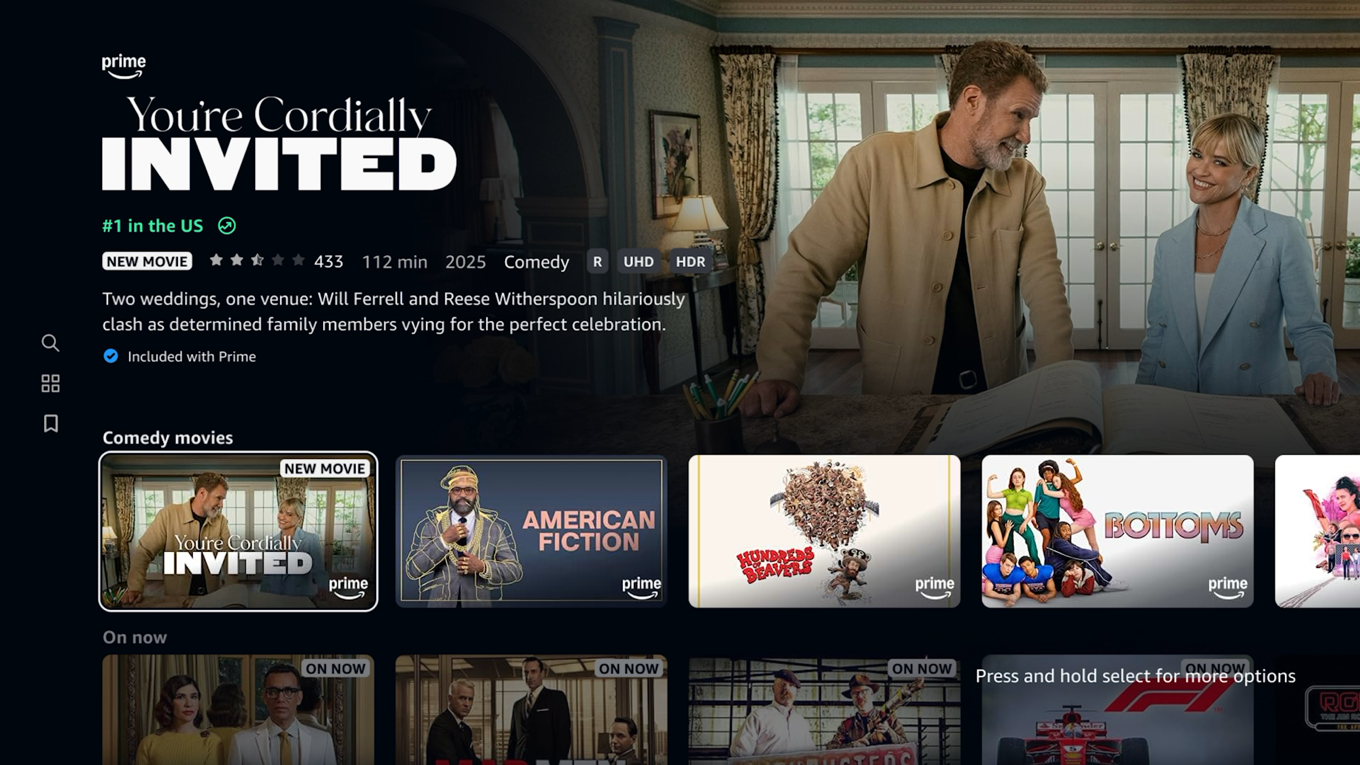
Overview
I led design on the relaunch of the Amazon Prime Video app on tvOS, rebuilding it as a fully native Apple TV experience. The existing app was a cross-platform port that never felt at home on the platform. It was slow, click-heavy, and frustrating to use. The goal was to make Prime Video feel fast, intuitive, and genuinely built for Apple TV.
The problem
Customer sentiment was blunt. People described the old app as "unusable," "jumpy," and "horribly clunky." Playback controls were so cumbersome that scrubbing through video was effectively broken. Navigation required too many clicks. Search had high drop-off rates. Accessibility features were missing or non-functional.
The root cause wasn't a handful of bad UX decisions. The app had been built for multiple platforms at once, and Apple TV had paid the price for that.
My role
I partnered with Product, Engineering, and Apple to shape scope, UX strategy, and launch decisions. My focus was on the three core journeys: navigation, playback, and search. I also pushed for accessibility to be treated as a baseline requirement rather than something addressed post-launch.
Approach
The guiding principle was to rebuild natively rather than port. That meant fully embracing Apple's interaction model instead of forcing a shared UI onto the platform. We also made a deliberate call to ship a Minimum Lovable Product, a version of the app that covered the core journeys well rather than waiting for full feature parity with the legacy experience.
Key design work
Navigation had to feel fast and fluid. I replaced click-based movement with velocity-based swiping and introduced free focus and directional navigation, which made browsing large catalogs much less frustrating.
Playback was where customers felt the most pain. Scrubbing went from a multi-click process to a single swipe, with real-time feedback tied to the motion of the gesture. What had previously taken 10 or more clicks could now be done in one.
Search needed to stop feeling like a dead end. I combined the keyboard and results into a single view so results appeared inline while typing, and added voice search via the Siri remote.
Accessibility was built in from the start. We enabled the full Apple accessibility suite, including VoiceOver, contrast settings, and motion controls, and closed gaps that had existed in the previous app for years.
Beyond the core journeys, we also integrated native platform features including SharePlay, Picture-in-Picture, and native focus states.
Constraints
We were doing a full rebuild with a small team, which meant we couldn't match the legacy app feature-for-feature at launch. We managed that by being deliberate about scope. If a feature wasn't part of the browse-to-play journey, it didn't make the cut for v1. The plan was always to ship something people loved using and iterate from there.
Outcome
The launch delivered a better experience across navigation, playback, and search. Customer feedback shifted noticeably. Where people had previously complained about clunky controls and jumpy performance, the post-launch themes were around speed, intuitive controls, and the app feeling consistent with other Apple TV apps.
VICE Media noted that the update made the app feel "more seamlessly blended" with Apple TV, calling out the gesture-based navigation, faster predictive search, and accessibility improvements. The piece put it simply: "Anything that can sweep away the clumsiness is a major win."
The rebuild also strengthened Amazon's relationship with Apple and established a more credible platform presence going forward.
Press coverage
The relaunch was covered positively across major Apple-focused outlets. Six Colors put it simply: "There was a time when Prime Video was one of the worst major streamer apps on tvOS, but those days are over." VICE noted that Prime Video and tvOS now felt "more seamlessly blended than ever," highlighting the gesture navigation, search improvements, and accessibility work specifically. 9to5Mac called it "a much more native-feeling tvOS experience than Amazon has ever had."